Odometer Fraud: 8 Warning Signs & How to Check Before Buying
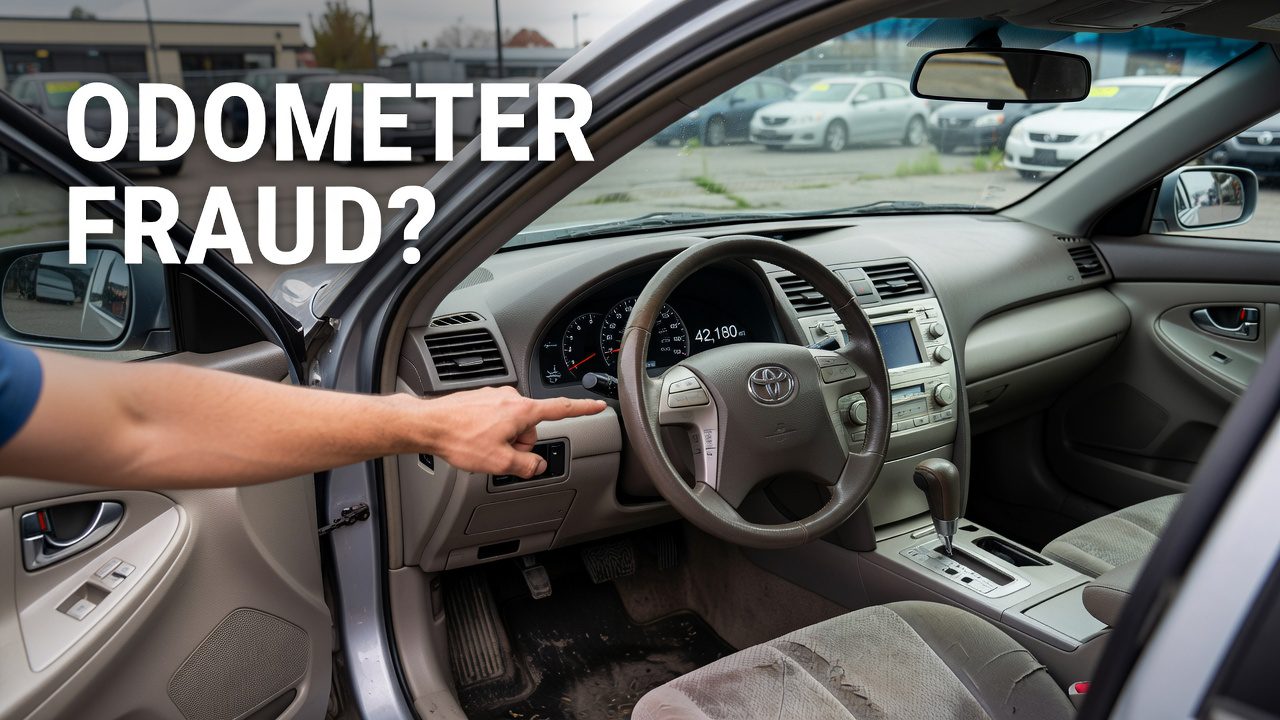
You found a 2017 Toyota RAV4 listed for $4,000 less than every comparable within 150 miles. The odometer in the photos reads 52,000, the seller says it was his mother’s car, and the title is “clean.” Then you see it in person: the driver’s seat left bolster is flattened, the steering wheel rim is polished smooth at the top, and the brake pedal rubber has a hole worn through the lower-right corner. That car has not traveled 52,000 miles — and the odometer may be lying to you.
Odometer fraud is not a 1980s problem. It happens on digital dashboards, on cars sold by people who seem normal, and on vehicles with clean titles. The National Highway Traffic Safety Administration (NHTSA) estimates that odometer fraud costs U.S. car buyers more than $1 billion every year. And it is not a minor paperwork issue: under the federal Truth in Mileage Act, altering an odometer to misrepresent a vehicle’s mileage is illegal.
On Car Hub, sellers list vehicles directly. Car Hub does not verify, inspect, or guarantee any listing. That means the odometer reading in an ad is a claim you need to test, not a fact you can trust.
Here’s how to spot a rolled-back odometer before you hand over your money.
What odometer fraud actually looks like
A rolled-back odometer is a vehicle whose displayed mileage has been reduced to make the car appear less used than it really is. The older method was physically rolling back mechanical numbers with a drill. The newer method is easier in some ways: a seller or shady shop plugs a scan tool into the car’s computer, reprograms the cluster, or swaps in a used cluster with lower mileage.
Sometimes a seller will call it “mileage correction” or “cluster repair.” If the goal is to hide real miles from a buyer, it’s not repair. It’s fraud.
Why do people do it? Because a car with 60,000 miles sells for thousands more than the same car with 160,000 miles. That price gap is the incentive. A seller who can make an 80,000-mile car look like a 40,000-mile car can pocket several thousand extra dollars.
Warning signs that the miles don’t match the car
You don’t need to be a mechanic to notice most red flags. You need to look at the things sellers forget to replace.
1. The price is suspiciously low
If a car is listed for $3,000 to $5,000 below every comparable model with the same mileage, that’s not automatically fraud. But it’s a reason to get more suspicious, not less. A seller who knows the real mileage is higher may underprice the car to move it fast before anyone asks questions.
2. Interior wear says more than the odometer
Pay attention to the high-touch areas:
- Driver’s seat left bolster
- Steering wheel rim at 9 and 3 o’clock
- Brake and clutch pedal pads
- Shifter knob
- Armrest
- Floor mat under the driver’s heel
A car showing 35,000 miles should not have a brake pedal pad worn through to the metal backing. A little shine on the steering wheel at 35,000 miles is possible if the previous owner used hand lotion. A cracked, polished rim at 35,000 miles is not.
3. Service records and stickers show higher miles
This is one of the strongest forms of evidence because it’s hard to fake. Look for:
- Oil change stickers on the windshield or door jamb with a date and mileage
- Emissions inspection reports that list mileage
- Service receipts from a previous owner
- Tire rotation or brake repair invoices
If the dash says 55,000 but a Jiffy Lube sticker from 18 months ago says 89,000, you found a rollback. It’s that simple.
4. The title has an odometer brand
Different states use different wording, but the most common title brands include:
- “Not Actual Mileage”
- “Odometer Discrepancy”
- “Exceeds Mechanical Limits”
- “Tampered”
These brands mean someone — a previous owner, a dealer, or a state DMV — flagged the mileage at some point. Some sellers will say it’s a paperwork mistake. Maybe. But a branded title makes the car harder to sell and easier to negotiate down. If you see one of these brands, the safest move is to skip the car entirely.
5. The gauge cluster looks disturbed
Look at the plastic trim around the instrument cluster. Scratched screw heads, pry marks, loose panels, or a cluster that sits slightly off-center can mean someone removed it. Ask why.
A legitimate reason exists: a failed cluster may be replaced with a used one. But a legitimate replacement should come with documentation — a receipt from a repair shop, a door jamb sticker noting the mileage at replacement, or a state inspection record. A cluster with no paperwork is indistinguishable from a rollback.
6. Tire age and wear don’t match
Every tire has a four-digit DOT date code on the sidewall. The first two digits are the week of manufacture, the last two are the year. A tire with “3219” was made in the 32nd week of 2019.
A car showing 25,000 miles with original tires worn to the wear bars is unusual. Tire wear alone doesn’t prove fraud because alignment problems can chew through tires early. But combine it with two or three other signs and the picture gets clearer.
7. New parts hide old age
A car with 45,000 miles may still have its original suspension components. If it has brand-new control arms, CV axles, a replaced transmission, or fresh paint on the front end at 45,000 miles, ask for receipts. Sometimes it means the car was in a crash. Sometimes it means the car has far more miles than the odometer claims.
8. The seller’s story falls apart
Watch for:
- “No service records, the previous owner lost them”
- “I just bought it and flipped it”
- “Grandpa only drove it to church on Sundays”
- “Digital odometers can’t be rolled back”
- “I’ll sell it for cash only, no title issues”
A seller who won’t sign a mileage disclosure or avoids written answers is a seller you should not trust with money.
Quick red flag checklist
Use this before you pay for a car.
| Check | What to look for | Why it matters |
|---|---|---|
| Title mileage | Compare the printed mileage on the title to the dash | A title reading 110,000 while the dash shows 60,000 is a dealbreaker |
| Title brands | “Not Actual Mileage,” “Odometer Discrepancy,” “Exceeds Mechanical Limits” | These brands mean the mileage has been flagged |
| Vehicle history report | Mileage entries over time, rollback alerts, title transfers | Mileage should climb steadily; sudden drops are red flags |
| Service records | Oil change stickers, inspection reports, repair receipts | A paper trail with higher miles than the dash is hard to fake |
| Interior wear | Seat bolsters, steering wheel, pedals, shifter, armrest | Low-mileage cars can show some wear, but not deep holes or cracks |
| Gauge cluster | Scratched screws, gaps, tamper dots, warning lights | Cluster removal can indicate a rollback or swap |
| OBD-II scan | Stored mileage in ECU or body module, if available | Mismatches between stored and displayed mileage are evidence of tampering |
| Pre-purchase inspection | Suspension, engine, brakes, hidden damage | A mechanic can spot 100,000-mile wear on a “40,000-mile” car |
How to check before you pay
This is the part where you do the work yourself. It takes less time than you think.
Step 1: Run a NMVTIS vehicle history report
Before you even go see the car, ask the seller for the VIN. Then run a vehicle history report through a provider approved by the National Motor Vehicle Title Information System, or NMVTIS.
NMVTIS is a national database run by the U.S. Department of Justice. It pulls title, junk, salvage, insurance, and odometer records from state DMVs, insurance carriers, and salvage yards. You can find approved providers at vehiclehistory.gov. A report usually costs less than $15.
If the report shows an odometer rollback, a mileage drop, a title brand, or a salvage history the seller didn’t mention, don’t go see the car. You just saved yourself time and gas.
Step 2: Read the title before money changes hands
Ask to see the physical title, not a photo on a phone. Look at the mileage section. Some states print the mileage at the last transfer. Compare it to the dash.
If the title says 98,000 and the dash shows 42,000, the seller needs documentation, not a story. Also look for any of the title brands listed above. If you see “Not Actual Mileage” and the seller says it’s a typo, walk. There are too many other used cars for sale to gamble on a title brand.
Step 3: Look at service records and stickers
Open the driver’s door and check the door jamb. Look at the windshield. Look in the glovebox. Oil change stickers and inspection reports list the date and mileage at the time of service. Service receipts may show a mileage history over time.
A car that shows 55,000 miles should have at least a few service records. If the seller has no records, that’s not proof of fraud by itself, but it means you have less evidence the mileage is real. Treat that as a risk factor.
Step 4: Inspect the wear items
You can do this in five minutes.
Sit in the driver’s seat. Does the left bolster collapse? Does the seat feel like it has 100,000 miles of rear-end pressure on it? Put your foot on the brake pedal. Is the rubber pad worn smooth or through? Grab the steering wheel at 9 and 3. Is the rim polished flat? Look at the shifter and the armrest.
Some wear is normal at any mileage, but deep wear at low mileage is not.
Step 5: Scan the car with a diagnostic tool
Many cars built since the late 1990s store mileage in the engine control module or body control module, not just the gauge cluster. A mechanic or a knowledgeable friend with a scan tool can read the stored mileage on some vehicles.
If the stored mileage reads 130,000 and the cluster shows 70,000, the cluster was likely replaced or reprogrammed. Not every car stores mileage in a readable module, so a matching scan doesn’t guarantee the odometer is accurate. But a mismatch is a dealbreaker.
Step 6: Get a pre-purchase inspection
Pay a mechanic to inspect the car before you buy. Tell them you’re specifically worried about odometer fraud. Ask them to check:
- Suspension bushings and ball joints
- Engine mounts
- Brake pad and rotor wear
- Transmission fluid condition
- Seat and pedal wear vs. claimed mileage
- Stored diagnostic codes and module mileage
A pre-purchase inspection usually costs between $100 and $200. That’s cheap compared to buying a car with hidden 100,000-mile wear.
If you’re selling a car
This works the other way too. Never “correct” an odometer to lower the reading. A legitimate cluster replacement should be done by a licensed shop, documented with a receipt, and disclosed in writing. If you roll back the miles and get caught, you can face federal criminal charges, state fines, and civil lawsuits from the buyer.
A title branded “Not Actual Mileage” can also make your car nearly impossible to sell later. Honest disclosure is cheaper than fraud.
What to do if you find a rolled-back odometer
If you haven’t bought the car yet: walk away. Do not try to negotiate a “great deal” on a car with odometer fraud. You don’t know what else the seller hid.
If you already bought the car and later discovered the mileage was false, report it to your state DMV and NHTSA. You may also want to talk to an attorney about your options in your state.
The bottom line
The odometer is a number, not a fact. Before you buy any used car from a private seller or a dealership, check the title, run a NMVTIS report, look at the wear items, and get a mechanic to inspect it. If two independent sources don’t line up — say the title says 90,000 but the dash says 45,000 — walk away.
There are too many used cars for sale to gamble on a rolled-back odometer.
This article is general information and not legal advice. Odometer laws and disclosure requirements vary by state. If you suspect odometer fraud, contact your state DMV or an attorney.