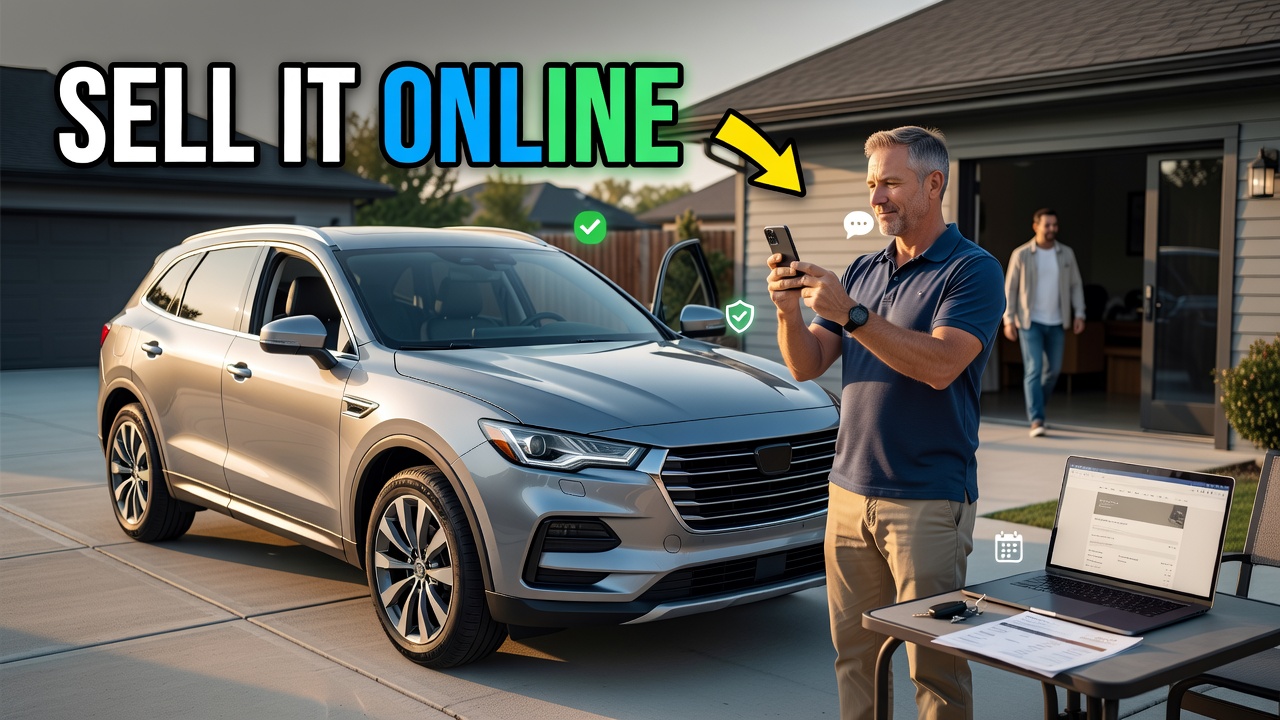
How to Sell Your Car Online: A Step-by-Step Guide
How to Sell Your Car Online: A Step-by-Step Guide
Four months after selling his sedan, a seller started receiving toll violations. Then a parking citation. Then a notice about an unpaid registration renewal.
He’d handed over a signed title and taken cash, and everything about the sale had gone fine. What he hadn’t done was file the notice of transfer with his state, which meant the vehicle was still recorded in his name long after someone else was driving it.
Selling a car online is mostly straightforward. The parts that go wrong are administrative, they happen after the money changes hands, and almost nobody warns you about them.
Choose how you’re selling before anything else
Four routes, and they trade price against effort in predictable ways.
| Route | Typical price | Speed | Effort | Main drawback |
|---|---|---|---|---|
| Private online listing | Highest | Days to weeks | Highest | Screening buyers, test drives, paperwork |
| Instant online offer | Middling | Very fast | Lowest | Offer often revised after inspection |
| Dealer trade-in | Lowest | Immediate | Lowest | Tied to buying from that dealer |
| Consignment | High minus fee | Slow | Low | You wait, and you pay a percentage |
Private online listing
The most money and the most work. You set the price, you keep the whole amount, and you handle everything from photographs to the title signing.
For a vehicle worth several thousand dollars, the gap over a trade-in is usually large enough to justify a weekend of effort. This guide is mostly about doing that route properly.
Instant online offers
Enter details, receive a number, drop the car off. Genuinely convenient.
The thing to watch: many of these offers are conditional on an inspection, and the final number can drop once someone looks at the car. Photograph the vehicle thoroughly before handing it over so you have evidence of its condition if the offer gets revised.
Trade-in
Fastest and lowest. It makes sense when you’re buying from that dealer anyway, and in some states a trade-in reduces the sales tax you pay on the new vehicle — which can close part of the gap against a private sale. Worth checking your state’s rule before dismissing it.
Consignment
A dealer sells it for you and takes a cut. Reasonable if you have no time and no appetite for strangers, and slow because your car is competing with everything else on their lot.
Get the paperwork ready before you list
This is the step people leave until a buyer is standing in their driveway, and it’s the one that kills sales.
The title
You need it in hand, in your name, and unbranded. A buyer who arrives to find the title is “in a drawer somewhere” or “at my ex-wife’s house” walks away.
Two rules that matter legally. Don’t sign the title until the buyer is present and paying — a signed title with the buyer’s section blank is an open title, and passing one along is illegal in most states. And don’t make corrections. Crossing out an error or using correction fluid can void the document, and you’ll be applying for a duplicate.
If the title is lost, apply for a replacement before you list. It takes time you don’t want to discover you need mid-sale.
If there’s still a loan on it
The most common thing that derails a private sale, and it’s manageable if you plan it.
When a car is financed, the lender typically holds the title. You can’t hand over what you don’t have, so the sale has to be structured around paying off the loan and releasing the lien.
Call your lender and ask for a 10-day payoff quote — the exact amount to clear the loan including interest to a given date. Then ask how they handle a private sale. The cleanest arrangement is meeting the buyer at a branch of the lender’s bank, where the buyer’s payment clears the loan directly and the lien release is initiated on the spot.
Tell buyers up front that there’s a lien and how you plan to handle it. Sellers who hide this lose buyers at exactly the wrong moment.
Odometer disclosure
Federal rules require an odometer disclosure at transfer for most vehicles. The exemption used to apply to anything over ten years old; the rule changed so that vehicles from model year 2011 onward require disclosure for twenty years.
In practice: the disclosure is either printed on the title itself or on a separate form your state provides. Fill it in accurately, and don’t guess the mileage.
Bill of sale
Not required in every state and worth doing everywhere.
Include the year, make, model, VIN, mileage, sale price, date, and both parties’ names, addresses, and signatures. Note “sold as is” if that’s the agreement. Both parties keep a copy — photograph it before you part.
The notice of transfer, and why it matters
The step from the opening story.
Most states let you file a release of liability or notice of transfer, often online, immediately after the sale. It records that you no longer own the vehicle, which protects you from tickets, tolls, and anything else that happens under that plate afterward.
Find the form for your state through USA.gov’s state motor vehicle services directory and file it the same day. It takes a few minutes.
State-specific extras
Rules vary more than people expect. Some states require the seller to provide a current emissions or smog certificate. Some require plates to stay with the seller; others transfer them with the car. Some require notarization of the title.
Check your state’s requirements before you list rather than discovering them at the signing.
Price it where buyers will actually find it
Use completed sales, not asking prices
Active listings tell you what hopeful sellers want. Completed sales tell you what buyers paid, and only one of those is a price.
Search your exact year, model, trim, and drivetrain, and pay attention to mileage bands. A trim difference can be worth more than a 20,000-mile difference.
Adjust honestly
Start at the middle of the range for comparable vehicles, then adjust down for anything a buyer will discount: missing service history, worn tires, cosmetic damage, a second key you don’t have, or a lien that complicates the transaction.
Adjust up for documented maintenance, recent major work with receipts, and a clean, complete package.
Price to land inside search filters
The tactic most private sellers miss.
Buyers search in round brackets — under $10,000, under $15,000, under $20,000. A car priced at $15,200 is invisible to everyone filtering under $15,000, and that’s a large share of the people who would have bought it.
If you’re close to a threshold, come in just under it. Losing a few hundred dollars of asking price to appear in a filter that thousands of buyers use is a trade worth making, and you’ll usually recover it by selling faster.
Leave a small margin for negotiation above your real floor — enough for one round, not enough to look inflated.
Prepare the car
Clean it properly
The highest return on effort in this whole process. A professional detail costs a modest amount and changes how every photograph looks and how the car feels on a test drive.
If you’re doing it yourself: wash and clay the paint, clean the wheels and tires properly, shampoo the carpets and mats, wipe down every interior surface including door jambs, clean the glass inside and out, and empty the car completely. Remove the air freshener — buyers read strong scents as covering something.
Fix what’s cheap, disclose what isn’t
A position worth stating plainly: fix the small stuff, disclose the big stuff, and don’t do a bad job of anything in between.
Worth fixing: burned-out bulbs, wiper blades, a dead key fob battery, low fluids, a missing hubcap, minor scratches that polish out. All cheap, all things buyers use to argue the price down by more than the repair cost.
Worth disclosing instead: anything mechanical and expensive. A cheap patch on a real fault gets discovered at the buyer’s inspection, and at that point you’ve lost both the money and the buyer’s trust.
Never worth doing: a rushed cosmetic repair right before selling. Mismatched paint and a hastily fitted panel say more about the car than the damage would have.
Clear any open recalls first
A step almost no seller takes, and it costs nothing.
Run your VIN through the NHTSA recall lookup. Open recalls are repaired free by a franchised dealer regardless of the car’s age or how many owners it’s had.
Two reasons to do it before listing rather than after. Buyers increasingly run this check themselves, and an outstanding recall becomes a negotiating point. And a dealer visit for recall work generates a service record in the manufacturer’s system, which is one more piece of documented history working in your favor.
Book it as soon as you decide to sell, since parts availability can add a wait.
Gather everything that came with it
Both keys, the owner’s manual, service records, the spare tire and tools, any accessories. A complete package sells for more and sells faster, for the same reason a documented service history does — it removes doubt.
Photograph it properly
Conditions
Overcast daylight or the hour before sunset. Avoid harsh midday sun, which blows out highlights and hides paint condition, and avoid flash entirely — buyers read flash photos as concealment.
Find a plain background. An empty parking lot, a quiet street, a wall. Not your driveway with the bins visible, and not a busy road.
Clean the car immediately before shooting, then check for your own reflection in the panels.
The shot list
Twenty to thirty photos. More than most sellers take and fewer than a gallery nobody scrolls.
- Front three-quarter view — this is your thumbnail, so make it the best one
- Rear three-quarter view
- Straight-on front, rear, and both sides
- All four wheels, with tread visible
- Full interior from the driver’s door
- Front seats, then rear seats
- Dashboard with the car running, showing no warning lights
- Odometer, clearly readable
- Infotainment screen powered on
- Trunk, empty
- Engine bay
- Both keys together
- Service records fanned out
- Every flaw, close up, individually
Photograph the flaws deliberately
The counterintuitive part, and it’s consistent across every used market: buyers pay more when they can see what’s wrong.
An undisclosed scratch found at the meetup becomes a renegotiation from a position of distrust. The same scratch, photographed and captioned in the listing, is just a fact the price already accounts for.
Protect your privacy
Blur or crop the license plate. Don’t shoot in front of your house in a way that identifies it. Strip location metadata if your platform doesn’t do it automatically.
Write the listing
The title
Buyers filter and scan. A title full of adjectives matches nothing.
Use: year, make, model, trim, drivetrain, mileage, and one genuine differentiator. Something like “2016 Honda Accord EX-L V6 — 89k miles, one owner, service records.”
Leave out exclamation marks, capitals, “must sell,” and “no lowballers.” Those describe your mood rather than the car, and they signal a difficult transaction before anyone has said hello.
The description
Six short blocks, in the order buyers ask about them.
What it is. Year, trim, engine, drivetrain, mileage, and how long you’ve owned it.
Condition, specifically. Not “great shape” — describe the actual wear and where it is. Vague praise is worth nothing because every listing has it.
Maintenance and recent work. What’s been done, when, and at what mileage. This block does more work than any other and most private listings skip it.
Known issues. Whatever they are. Disclosed problems cost less than discovered ones.
What’s included. Both keys, records, spare, accessories.
Terms. Price, whether it’s firm, where you’ll meet, and that the buyer is welcome to arrange an independent inspection. That last line signals confidence and filters out people who weren’t serious.
Keep the whole thing under about 300 words. Buyers scan.
What to leave out
Your home address, your daily schedule, your phone number in the public listing body, and the full VIN if the platform doesn’t require it — serious buyers can ask.
Screening buyers, scams, and test drives
The patterns worth recognizing
Most bad inquiries follow one of a few scripts.
The overpayment. A buyer sends more than the asking price and asks for the difference back. The original payment reverses later; your refund doesn’t. Any transaction involving sending money back to a stranger is a scam, without exception.
The shipper. An out-of-state buyer who’ll pay sight-unseen and arrange transport, usually with an escrow service they recommend. The escrow service is theirs.
The report link. A “buyer” who insists you purchase a vehicle history report from one specific site before they’ll proceed. That link is the scam — either phishing or an affiliate racket. Legitimate buyers run their own reports, and they can check title brands free through the government’s National Motor Vehicle Title Information System.
The instant yes. Anyone who agrees to your full asking price without questions, without seeing the car, and wants to move fast is not buying a car.
Communicating safely
Keep the conversation on the platform as long as you can. Use a separate number if you have one. Don’t share your address until you’ve decided to meet, and consider meeting somewhere neutral first.
Test drives
- Ask for a photo of their driver’s license before the drive, and keep it.
- Confirm they’re insured. In most cases your policy covers a permissive driver, but check yours specifically before the day.
- Ride along. Always.
- Choose the route yourself — a mix of surface streets and highway, twenty minutes.
- Meet in a public place with daylight and foot traffic. Many police departments provide designated exchange areas.
- Bring someone, or at minimum tell someone where you’ll be and when you expect to be back.
- Don’t leave the car running unattended while you talk.
- Expect an inspection request — a serious buyer will want an independent mechanic to look at it, and agreeing makes you look like someone with nothing to hide. Our pre-purchase inspection checklist covers what they’ll be looking at.
Buyers arriving with the checks from our used sedan guide or used SUV guide are the good ones. Thorough buyers close.
Payment, paperwork, and closing out
Getting paid
The rule underneath everything: the car and title move when the money is irreversible, and not before.
Best: meet at the buyer’s bank, watch the funds withdrawn or the cashier’s check issued in front of you, and deposit it immediately. If there’s a lien, meet at your lender’s branch instead.
Acceptable: a wire transfer you’ve confirmed as landed in your own account — not a screenshot, not a pending notification.
Avoid: personal checks, money orders, anything mailed, and any payment app where the funds can be reversed after the fact. Cashier’s check fraud is common enough that verifying the check with the issuing bank, in person, is worth the trip.
At the signing
Complete the title with the buyer present. Both parties sign the bill of sale. Fill in the odometer disclosure accurately. Hand over both keys, the records, and the manual.
Photograph the completed title and bill of sale before you part with anything.
Immediately after
Five things, the same day:
- File the notice of transfer or release of liability with your state.
- Remove your plates if your state requires it, and return or transfer them per your state’s rule.
- Cancel or transfer your insurance — after the transfer is recorded, not before you’ve handed the car over.
- Remove the toll transponder from the windshield.
- Wipe the car’s digital footprint. Factory reset the infotainment, remove paired phones, delete saved addresses including your home, clear garage door openers, and remove the vehicle from any connected-car app tied to your account. That last one gets forgotten constantly, and it can leave a stranger with remote access to a car and a former owner with location data they shouldn’t have.
Worth mentioning to the buyer if you had transferable coverage on the vehicle — our guide to extended car warranties covers how transfer works and what it’s worth.
Common mistakes to avoid
- Listing before you have the title in hand. The most common reason a sale collapses.
- Signing the title before the buyer is present. An open title is illegal in most states.
- Hiding a lien. Buyers find out, and you lose them at the worst moment.
- Pricing just above a search threshold. Invisible to a large share of buyers.
- Photographing with flash, in midday sun, or with the car dirty. All three read as concealment.
- Hiding a flaw. Discovered problems cost more than disclosed ones.
- Accepting a payment that can be reversed. A screenshot is not money.
- Skipping the notice of transfer. Tickets and tolls follow the registration, not the driver.
- Leaving your data in the car. Home address, paired phones, and connected-app access all travel with it.
Frequently asked questions
How do I sell a car that still has a loan on it?
Get a 10-day payoff quote from your lender and ask how they handle private sales. The cleanest method is completing the transaction at a branch of the lender’s bank, where the buyer’s payment clears the loan and the lien release begins immediately. Tell buyers about the lien up front.
What paperwork do I need to sell a car privately?
The title in your name, an odometer disclosure, and a bill of sale at minimum. Depending on your state you may also need an emissions certificate, a notarized signature, or a specific transfer form. Check your state’s requirements before listing.
What’s the safest way to accept payment?
Meet at the buyer’s bank and watch the cashier’s check issued, or confirm a wire has landed in your own account. Both are effectively irreversible, which is the property that matters.
Should I let a buyer take the car for an inspection?
Yes, at a shop you both agree on, ideally with you present or following. Refusing makes serious buyers walk, and the ones who ask are usually the ones who buy.
Do I have to tell buyers about problems with the car?
Disclose known material defects — it’s the law in many states and it’s the better commercial decision everywhere. Undisclosed faults found at inspection cost you more in renegotiation than they would have in a lower asking price.
What do I do right after the sale?
File your state’s notice of transfer, handle plates per your state’s rule, cancel insurance once the transfer is recorded, remove the toll transponder, and wipe the car’s infotainment and connected-app access.
Before you photograph anything, find the title and confirm it’s in your name and free of errors. That single check determines whether the rest of this process takes a weekend or a month, and it’s the one most sellers do last.
Ready to list? Put your car in front of buyers at CarHub and take the shot list above with you when you go out to photograph it.
About the author
Emran Ahmed is the founder and CEO of CarHub, a marketplace for buying and selling used cars across the United States. The toll-violation story at the top came from a seller who called months after a sale asking what he’d done wrong. He’d done almost everything right and skipped one form. Emran now mentions the notice of transfer before he mentions anything else.
Suggested follow-up posts
- Selling a car with a loan on it: how to structure the transaction
- Bill of sale template and what your state requires
- How to price a used car against completed sales
- Car selling scams: the scripts that keep working
- Trade-in vs private sale: running the numbers including tax